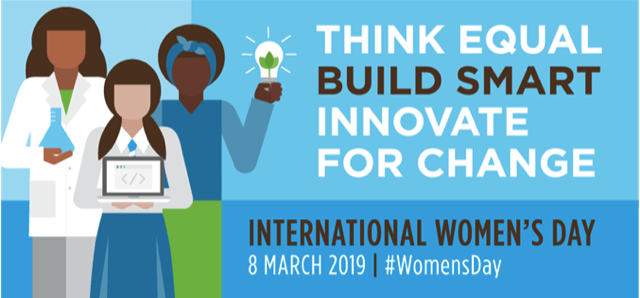
A logo reading "Think Equal, Build Smart, Innovate for Change, International Women's Day, 8 March 2019| #WomensDay" The logo has a blue background. Three illustrated women with no faces stand by the text. One woman represents a scientist, wearing a white lab coat and holding a vial. One woman holds a laptop wearing a sweater and a long blue skirt. One holds a lightbulb, and a green leaf floating within. She wears a headband around her afro, a blue sweater, and long green bottoms.

International Women’s Day, celebrated on March 8th, is a time to reflect on the progress made for women over the last 100 years and celebrate their courageous acts throughout history.[1]  It is also a time to call for continued change.

The Continued Uneven Playing Field

Despite the movement to propel women’s opportunities, corporate America continues to allow an uneven playing field.

A recent study, Women in the Workplace 2018, by McKinsey & Company and in partnership with LeanIn.Org, found that the growth of women at every level in corporate American has stalled.[2] While the study found that women are doing their part – earning more bachelor degrees, asking for promotions, negotiating better salaries, and staying in the workforce at the same rate as men  – women remain unrepresented at every level.

It begs to question if women are doing their part – what’s the problem?

The Answer – Companies are not held accountable.

While the vast majority of companies say they are committed to gender diversity – the evidence indicates otherwise. Women are less likely to be hired for entry-level positions and promoted to manager-level jobs. The disparity widens further – and further – as promotions hit the C-Suite level. Factors such as discrimination and sexual harassment contribute to lack of diversity in the workplace.


Discrimination

Gender discrimination can take many forms, yet it always signals disrespect. It is also illegal under Title VII and the Minnesota Human Rights Act, among other laws. Sexism can be subtle, such as a male coworker questioning a female coworker’s judgment on an area of expertise. It can be severe, such as a male manager making a derogatory sexist comment to a female colleague. As negative experiences compound over time, women view their workplaces as less fair and are three times more likely to leave their jobs.[3]


Sexual Harassment

Thirty-five percent of women in corporate America experience sexual harassment at some point in their careers, such as hearing sexist jokes to being touched in an inappropriate sexual way. Women who do not conform to traditional feminine expectations – holding authority and working in male-dominated fields– are more likely to be targeted. Despite the momentum of the #MeToo movement, we need continued emphasis that sexual harassment is unacceptable and will not be ignored.


Take Charge

If you have experienced discrimination or sexual harassment, know that you are not alone. We can help. For over 20 years, Halunen Law has fought for the rights of both men and women, who are subject to unwelcome sexual comments and behavior, as well as those subject to unlawful discrimination. We hold employers accountable so that you can feel safe in the workplace.

Learn more about International Women’s Day 2019


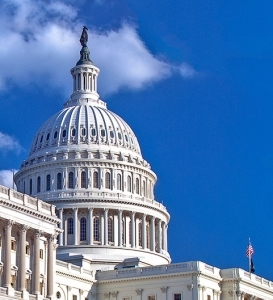
Photo of the dome of the senate building from below framed in blue sky.Older workers are one significant step closer to enjoying the same federal protections as other protected classes after the U.S. House of Representatives passed the Protecting Older Workers Against Discrimination Act (“POWADA”) on January 15, 2020. The Bill, if enacted, would amend the standard for employees alleging discrimination under the Age Discrimination in Employment Act, Title VII of the Civil Rights Act of 1964, the Americans with Disabilities Act, and the Rehabilitation Act of 1973.
In 2009, the United States Supreme Court decided in Gross v. FBL Financial Services, that in order for an employee to prove that an employer violated the Age Discrimination in Employment Act, an employee needed to show that he or she was terminated because of age.[1] Before Gross, age discrimination was treated just like discrimination based on other employee protected classes, such as race, color, sex, national origin, religion, or disability, which require an employee to prove that discrimination only played a role in the employer’s decision. POWADA would reverse the Gross decision and return older workers to the same playing field as other protected classes.

Read More…

Applying for a job can be the ultimate test of one’s confidence, especially in light of a new study which found that employment interviews are more often given to candidates with current jobs or who were recently laid off, as opposed to those candidates who had been unemployed more than 26 weeks. In fact, many employers didn’t even consider jobless applicants, screening out their applications even before the interview stage.

Yet the subject of screening out applications can be a sensitive one. As a preliminary matter, the Minnesota Human Rights Act prohibits employers from requesting certain information from job applicants before they are hired. If an employer requests pre-employment information pertaining to an applicant’s race, religion, national origin, public assistance, sex, marital status, sexual orientation, age, creed, or disability, that employer may find itself subject to potential liability, save for a few codified exceptions.

Read More…

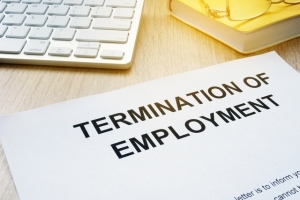
A sheet of paper reading "termination of employment" rests on a desk between a book and a laptop.You’ve just been fired, or you suspect you’re about to be fired. And you think that your termination may be for an illegal reason (e.g., discrimination, retaliation, blowing the whistle). Now what?


1. Do Not Quit / Do Not Sign Anything. Most workers who suspect termination is imminent often believe it is better to quit than be fired. But depending on the circumstances, that might not be true. Voluntarily leaving your position before your employer takes any adverse employment action against you (e.g., a termination), could weaken your ability to make an employment claim. Often it is wiser to continue to do your job well, which means that your employer will have to terminate you to make you leave. However, there could be extenuating circumstances that would warrant a different decision. If you are tempted to quit your job, it would be wise to contact an employment attorney before quitting to discuss your particular situation and your options.

At your termination meeting, your employer may present you with a document called a separation or severance agreement, potentially with an offer of some amount of money. Again, the wise thing to do is to consult with an attorney before signing anything. If you signed this document already and are having second thoughts, you should immediately contact an employment attorney to review the agreement on your behalf. If you act quickly enough, you may be able to rescind your agreement.

Read More…

A professionally dressed man and a woman walk toward the glass doors of the airport. They both carry bags and roll suitcases behind them.

Sexual harassment or sexual assault can be actionable if it occurs on business travel or at work-related events.  In fact, over half of the sexual assault cases we have handled involved assaults that occurred outside of the office and outside of work hours.  If the harassment or assault can be shown to be related to the employment relationship and the incident is sufficiently severe or repetitive, you may have an actionable claim against your employer.

Minnesota law prohibits discrimination in employment on the basis of sex, including sexual harassment.  Sexual harassment “includes unwelcome sexual advances, requests for sexual favors, sexually motivated physical contact or other verbal or physical conduct or communication of a sexual nature when . . . that conduct or communication has the purpose or effect of substantially interfering with an individual’s employment . . . or creating an intimidating, hostile, or offensive employment . . . environment.” Minn. Stat. § 363A.03, subd. 43(2).

Read More…

An older man in an office setting holds a box filled with items from his desk as a younger man looks on.We hear all too often from clients…

“I just got laid off, and my employer wants me to sign a severance agreement. They gave me a big chart with a list of people’s positions and ages on it. I’m confused, and I’m not sure what to do next.”

If you are an older worker (defined as age 40 or older), stop right there! You likely have a lot of questions in your head right now. We’re here to help you find some answers.

Read More…

A small bronze statue representing Justice. A girl in draping cloth holds scales, her eyes covered in a blindfold. A new case decided by the Minnesota Supreme Court provides additional support to employees with disabilities—it clarifies that employers cannot terminate disabled employees who request an accommodation without a “thorough communication” and “documented good faith efforts” to see if the accommodation would actually pose an undue hardship.


Under the Minnesota Human Rights Act, employers are required to provide reasonable accommodations to qualified workers with disabilities to allow them to perform the essential functions of their jobs. But what do these terms mean?

Read More…

Recently the U.S. Supreme Court struck another blow against consumers and employees in the case of Lamps Plus, Inc.  v. Varela. Yet again the Court reasoned backward from the result it wanted to reach and went out of its way to find in favor of a corporate defendant – at the expense of individual citizens – by reading into a contract language that did not exist.

Read More…

In 2014, a Minnesota demographic survey conducted on State employees showed that less than 4% self-identified as having a disability. When compared to the presence of employees with a disability statewide and nationwide, 7.9% and 10.5% respectively, it was evident that the State’s workforce did not reflect the diversity of Minnesota’s population of individuals with a disability.

As a result, former Governor Dayton’s office issued Executive Order 14-14, which issued a goal for State agencies to increase employment for people with disabilities to at least 7% by August 2018. Fast forward four years, on August 29, 2018, former Governor Mark Dayton’s office announced that Minnesota met its goal to have 7% of its workforce identified as having a disability. This modest increase of individuals with a disability in the State’s workforce can be attributed in no small part to the implementation of a trial work program, Connect 700.

Read More…

A closely cropped illustration of the Minnesota flag focusing on the Minnesota seal in blue, red, and yellow.

A Victory to Minnesota Employees

The Minnesota Supreme Court has just handed a victory to Minnesota employees who have been disabled as a result of a workplace injury. The Court’s recent ruling in the Daniel v. City of Minneapolis case, states that employees who develop a disabling condition resulting from an on-the-job injury may now recover workers’ compensation benefits for that injury, and they may bring a separate claim for disability discrimination under the Minnesota Human Rights Act. This case overturns a 1989 Minnesota Supreme Court case, Karst v. F.C. Hayer Co., which held that the sole recourse for employees with disabilities resulting from an on-the-job injury was to receive workers’ compensation benefits. For three decades the Karst ruling has prevented employees with disabilities from a workplace injury from pursuing their rights under the Minnesota Human Rights Act. As a result of the Daniel decision, Karst has been overruled, and disabled employees across the state may now pursue all of the remedies they are entitled to under the law.

Minnesota Lawyer:

Read recent article in the Minnesota Lawyer about this case:

Court rules for firefighter in disability case

Star Tribune:

Read a recent article in the Star-tribune about this case:

Former Minneapolis firefighter will be able to sue for disability discrimination, high court rules

© 2026 Halunen Law | Minneapolis Employment Attorneys