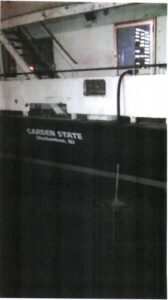
 Newark, NJ, December 4, 2020. A lawsuit filed by former employees of NY Waterway, which operates ferry vessels between New York and New Jersey, claims the company illegally dumped raw sewage, oil, fuel, coolant and other pollutants into New York harbor and surrounding waters for years while operating a fleet of 30 vessels that carry up to 30,000 passengers a day.
See the recent NY Times article.
Download the Amended Complaint.
In a recently unsealed complaint filed in the United States District Court of New Jersey, former NY Waterway fuelers and overnight mechanics Rafi Khatcikian and Ivan Torres allege that the company knowingly and intentionally forced them to discharge hundreds of gallons of liquid pollutants as well as batteries and aluminum shavings into the Hudson River, East River, Upper New York Bay, Lower New York Bay and Raritan Bay.
The complaint alleges that NY Waterway, under contract to the City of New York and Goldman Sachs, dismissed the concerns and complaints of the plaintiffs in order to cut costs, boost profits and remain on schedule. The company allegedly failed to maintain equipment designed to safely dispose of the pollutants and regularly told the plaintiffs to “get the job done” and lie about the illegal practices if asked, according to the suit. Both were threatened with termination if they took their concerns to management, and ultimately Khatcikian was fired for doing so, the complaint alleges.
“These brave defenders of the public interest are admitting their own wrongdoing in order to stop NY Waterway from further polluting the harbor and other local commercial and recreational waters,” said Michael D. Fitzgerald, co-counsel for plaintiffs. “They lost their jobs because of NY Waterway’s illegal practices, and then decided to put the interests of 15 million residents over their own futures. They are true environmental heroes.”
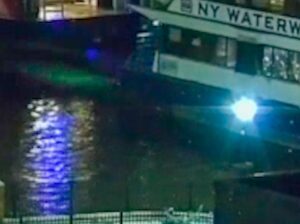 According to the complaint, videos and photographs taken by the former employees show workers dumping sewage through a hose thrown over the side of ferries and illegally dumping it directly into the Hudson River from the holding tanks. In one video, dye provided by the EPA to track the pollution is shown billowing across the river as employees scramble to disperse the evidence by stopping and starting engines at the dock. The ferry depicted in the video was taken out of service and its GPS device turned off before being moved to a New York-based dock, the lawsuit alleges.
The complaint alleges that when the EPA returned a few weeks later, the bathrooms on ferries under investigation were either locked or removed entirely. The removal of the bathrooms allegedly took place just days after NY Waterway received notice of Clean Water Act violations.
“NY cynically put out-of-order signs on bathrooms and even removed toilets once they learn they were being watched,” said Fitzgerald.
The complaint further claims that NY Waterway’s ferries engaged in the act of “running open,” an illegal practice where ferries would discharge their holding tanks while sailing between destinations. NY Waterway allegedly also delayed repairs of equipment and cooling systems until it knew federal inspectors were due, causing hundreds and hundreds of gallons of toxic waste to pollute the river and surrounding waters daily. Gerald Robinson, a Halunen Law attorney who also represents the plaintiffs, commented: “this case was brought under environmental laws allowing citizens’ suits, as well as the False Claims Act, showing the critical role that whistleblowers play in eliminating environmental injustice.”
According to the lawsuit, NY Waterway and affiliated companies improperly received approximately $9.6 million from federal and state agencies since 2015, including from the Department of Transportation, Federal Highway Administration, Federal Maritime Administration, Federal Emergency Management Agency and New Jersey Transit. NY Waterway unlawfully certified it was in compliance with all environmental laws in order to receive the money despite knowingly and illegally discharging pollutants every day, the complaint alleges.
About the Law Office of Michael D. Fitzgerald: The Law Office of Michael D. Fitzgerald is dedicated to those who have taken up the individual challenge and have committed themselves to reporting fraud and waste. Based in New Jersey, The Law Office of Michael D. Fitzgerald handles various employment related matters related to whistleblower issues including False Claims Act and Qui Tam matters.
About Halunen Law: With offices in Minneapolis, Chicago and Phoenix, Halunen Law offers experienced legal representation to employees, whistleblowers, and those who have been wrongfully injured. Halunen Law has achieved a reputation as a fearless, tenacious and successful plaintiffs’ law firm, with a laser focus on achieving justice for its clients. For more information visit halunenlaw.com.
If you feel you’ve experienced illegal action in your workplace, we encourage you to submit a Case Review Form to our firm. One of our attorneys will review your information, and you’ll receive a response from our firm in a timely manner. There is no charge for this confidential process. And, if we take your case, as a contingency-based law firm, there is no cost unless we win.
We’re here to help you navigate your lawful rights and ensure you get the treatment you deserve. Together, we can hold employers accountable and create a fairer workplace for everyone.
 As an attorney with Halunen Law’s FCA Practice Group, Nathaniel Smith is determined to bring fraudulent conduct to light, and to justice. Having recovered millions on behalf of whistleblowers in both employment retaliation cases and qui tam whistleblower lawsuits under the False Claims Act (FCA), he is relentless in his pursuit.
  If you suspect that your employer or some other entity is committing fraud against the government, here are some things you can do to increase your chances of bringing a successful False Claims Act case.
 Lon Leavitt joined Halunen Law after a successful 12-year tenure as an Assistant United States Attorney in the District of Arizona, one of the largest and busiest federal districts in the country. In that role, he managed False Claims Act investigations and litigation on behalf of the federal government in a wide range of fields, including health care, defense and education. Lon is especially knowledgeable in health care fraud enforcement, having pursued cases successfully against hospitals, hospices, physician groups, and other health care providers.
  The news in recent years has had many stories about “whistleblowers”—what they reported, what caused them to blow the whistle, and what happened as a result. Perhaps you have seen some sort of misconduct on the part of an employer, a corporation, a competitor, or a health provider. And you wonder “Am I a whistleblower?” or “What do I do?” Or perhaps you have already reported some wrongdoing and are wondering if you are now experiencing retaliation.
 A Partner at Halunen Law,
  It is unusual for any plaintiff or relator to achieve a summary judgment ruling in its favor in any type of case. But in
  The public-private partnership envisioned by the qui tam provisions of the False Claims Act (FCA) is one of its most successful and powerful aspects, yielding billions of dollars in recoveries. The FCA permits the Government, the whistleblower, and their attorneys to cooperate—and they often do—when investigating and litigating FCA claims. But are there limits to that cooperation? Can government officials ask a whistleblower to secretly record conversations between the whistleblower and individuals who are under investigation but are represented by an attorney? The answer, according to one federal court, is “yes.”
 One of the first and most frequent arguments defendants make in fighting qui tam allegations under the False Claims Act (FCA) is that the case brought by the whistleblower, or “relator,” is not viable because it is based on publicly available information, the relator is not an “original source” of that information, or both. On February 19, 2020, the First Circuit Court of Appeals issued an important decision clarifying that to qualify as an original source, a relator need not have participated in the fraud or observed it in operation. Instead, a relator may qualify as an original source if the relator sees or receives information that is suggestive of fraud, hears suspicious conversations, and discovers additional evidence of fraud through personal investigation. United States ex rel. Banigan v. PharMerica, Inc., No. 18-1487, 2020 WL 813258, at *8-9 (1st Cir. Feb. 19, 2020).
 We often write about the more common protections for employees in Minnesota, such as protections against discrimination, sexual harassment, retaliation for reporting law violations (i.e. whistle blowers), and protections for employees who take medical leave. But, did you know that Minnesota also provides lesser-known protections to employees? For example, Minnesota law allows employees to take up to 16 hours of time off work to attend their child’s school conferences and activities each year and for each child.
 Although Minnesota is an “employment at-will” state—meaning the employer may terminate an employee at any time for any reason—there are, in fact, exceptions to the rule. Since 1967 the Minnesota Human Rights Act has served as the State’s comprehensive employment rights law and provides a wide range of protections for employees. Yet even with the law in place, employers continue to violate employees’ rights in countless ways. Here are 20 of the most common violations for which an employee may seek monetary relief under the Minnesota Human Rights Act:
 A few years back, a news article reported that a meeting of corporate defense attorneys had called out whistleblowers as primarily “disgruntled employees.” This remark reflects a too-common perspective that whistleblowers are a nuisance rather than a contributor to the well-being of our businesses and our government. Far from being a nuisance, whistleblowers are champions of ethical conduct and play a powerful role in prodding businesses to do what is right. Are whistleblowers often disgruntled employees? Of course.